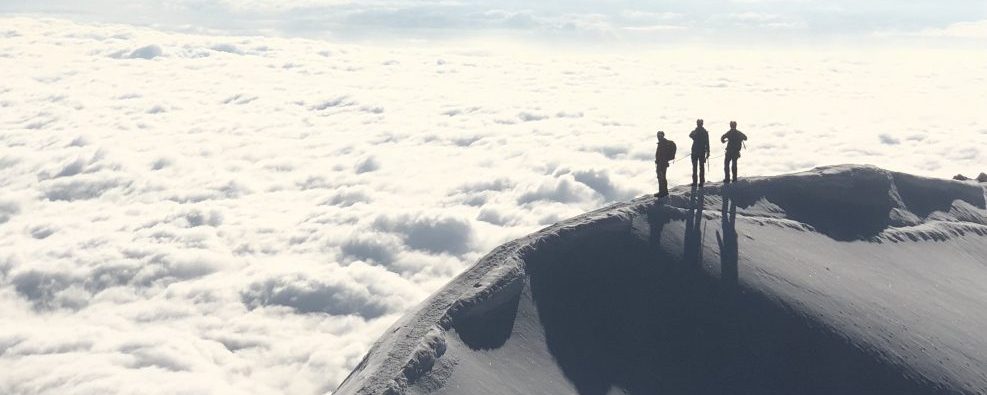
Spring in the Alps
The past two months has been a whirlwind, but here is a little update on what’s been going on at Into the Mountains…
After arriving in Chamonix at the beginning of March I began working almost immediately. The spring conditions in the Valley were more favorable this season for skiing than Alpine climbing so almost all of the work t I did was on skis. There are so many great lift accessed day tours from Chamonix it is hard to get bored. There is something for everyone no matter what your skiing ability or your fitness level. Some of the most memorable tours I did this spring included the Capucin couloir, the Aiguille Argentire, the “trios cols” tour on Caroline’s birthday with five or her girlfriends. And, of course, the spring wouldn’t be complete without a descent of the cosmiques coulouir, which I did with my friend Max in a late afternoon blitz with great snow conditions.
A large part of the spring ski season in the Alps are the hut trips and this spring I did two trips on the Haute route via two different variations. There are many ways to tackle the world renowned Haute Route and not matter which way you go it is sure to be an adventure you will remember. The fist trip that I did was in late March and unfortunately the weather wasn’t very cooperative. Nonetheless, we managed to ski a majority of the route and had some nice snow while doing so. Because of storms we weren’t able to complete the last leg to Zermatt, but a retreat to Arolla in a whiteout was a memorable experience for everyone.
On the second Haute Route trip I lead I skied with a father and daughter from Tucson and Boulder respectively. Evan, Heather and I opted for the “classic” variation which, while starting and finishing the same, takes a more technical and remote variation in the middle. In the mountains it seems like it is either one extreme or the other and this trip the weather was almost too nice… For the start of the trip we were fortunate to have blue skies, but it was hot! Warm springtime weather, while being great to work on your tan, can be a bit of a hazard in the mountains. Rapidly warming snow slopes and weak overnight freezes are something not to take lightly no matter what mountain range you are in. Because of these seasonally warm conditions we had early starts and finished quite early in the day. That means more time spent at the beautiful huts in the Alps indulging in local dishes and drinks wondering how you’re going to possibly burn off all of the extra calories…
By the end of the trip the weather had turned on us and it was quite a challenge making it to Zermatt. Nonetheless, with some GPS navigation and roped up skiing we managed to complete the trip. The final ski to Zermatt was a bit of a mess and included skiing on about every type of terrain possible except for good snow: slush, dirt, grass, rocks… It was a fitting end to the ski season for us all and we spent an entertaining night in Zermatt watching some bizarre music performances and the rain fall in town.
In between it all I also worked on a week ski trip in Switzerland, did many Vallee Blanche descents and began remodeling an apartment… Needless to say there was hardly a dull moment over the past couple of months. It is now to try and reverse the legs to arm ratio and get back into rock climbing shape. Caroline and I will both enjoy all little down time from guiding for the month of May and then will kick off the summer guiding season with some time on Mount Rainier before heading back to the Alps at the end of June. Our schedules are getting pretty full at the moment, but there are still some openings if anyone is thinking about taking that once in a lifetime summer climbing trip the Alps.
Preparation for Norway
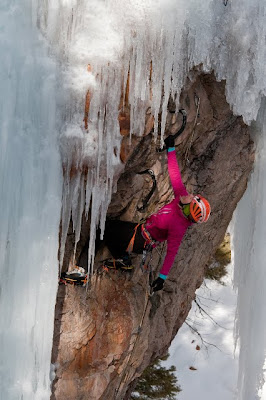


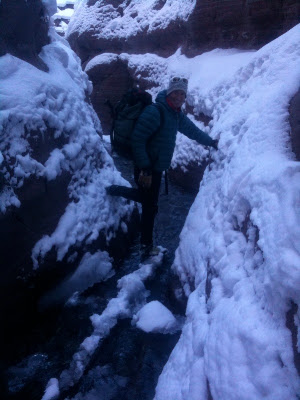


OR Show 2010
The Outdoor Retailer Show in Salt Lake City takes place each year in January, between the Ouray Ice Festival and Chicks with Picks. This is a great time for me to touch base with my sponsors (First Ascent, Petzl, Scarpa, Julbo) but also to see just about everyone I know in the Outdoor Industry. This year, Adam and I worked for Brooks Range Mountaineering. Brooks Range Mountaineering makes tarps, tents, rescue sleds, map reading tools, snow science kits, down jackets and elephant foot type of sleeping bag, ski straps, snow shovels, snow saws, etc. It’s a one of a kind company, owned and created by AMGA Alpine Guide Matt Brooks.  The new Rocket Tent, designed by IFMGA guide Dick Jackson, drew a lot of attention, because of the cutting edge untearable material it’s made out of. The tent is ultralite (1.5lbs) and can be built with trekking poles and a probe.
It was a lot of fun to work a crew of guides at the booth.
I got a chance to walk around the show and discover all the new exciting products. Here are a few!
Scarpa has a whole new line of sport climbing shoes! hard to pick one from the lot. They all are so attractive and cutting edge looking!


 Beautiful new lifestyle shoes… can’t wait to show them off when they come out!
New alpine boots! The Phantom Lite will now be the Phantom Guide, the Summit has been transformed into the fancy Mont Blanc. I will be trying this new boot on long Norwegian ice climbs! And the Triolet – perfect durable light summer alpine boot – has been revamped! Check it all out on the Scarpa Website!


Petzl is coming out with an awesome new line of products!
The Spirit carabiners have been one of Petzl’s most beloved products. No teeth, perfect shape, they are/were the must of biner. But with the new area of lightweight carabiners, Petzl took the time to perfect a new set of carabiners. The Angel (the draws to the left of the Spirits). The draws come in different lengths and the biners are color-coded: blue and orange for the bottom biner, grey for the biner you clip into the bolt. The Angel are no less than revolutionary.
Petzl also came out with a lighter Elios for women and for kids (bottom helmets on the picture).
And Petzl also came out with a much awaited new version of the Quark and of the Nomic, and added to the line the amazing Ergo (top ice axe, orange). The Ergo is radically curved with two pommels to make switching hands easier. I haven’t tried it yet, but rumor has it that it swings really well and is perfect for mixed climbing. More on that when I get to climb on it. What was missing on the Nomic – a hammer and a spike – no longer is! Petzl came up with an amazing idea: a removable hammer or adze. How genius is that? For my next alpine adventure, I can choose to carry a hammer – or not – along, depending on what my objective is! The handle is smaller and  is more attractive with the added orange. And the added spike makes this tool a lot more versatile!
The new Quark should have been called Transformer. It can do so many things at once, it’s awesome! It adapts to whatever you want to do: pure ice, alpine route, mountaineering, etc. It’s small and light enough that you will always want it along! The hand grip can be removed so that the spike works better. The pommel can moved up and out of the way on alpine climbs, or put above the handle so that you can switch hands on it, the hammer is removable, etc.!
Petzl also came out with more powerful and more stylish (!) headlamps. They come in all sorts of colors. My favorite, of course, is the pink one! But moreover, Petzl came out with a rechargeable battery. Now you can recharge your headlamp with your USB port or any other charger! Sustainable and ingenious, wouldn’t you say?
 Julbo needs no introduction in the Outdoor community. Just about every mountain guide I know – in Europe or in North America – wears Julbo sunglasses. And the reason for that is…? well, just coz they are the best on the market.
This year, Julbo came out with the Monte Rosa, a stylish and feminine alpine pair of sunglasses. Specs: For those ladies who explore the summits yet also enjoy the hustle and bustle of urban life, Julbo presents the Monta Rosa. With removable shields, high protection lenses and a curved ergonomic shape, the MonteRosa offers adaptability, versatility and complete protection.
Julbo owner Christophe Beaud obviously doesn’t think that the Monte Rosa should be limited to women! 
The Whoops  is are made for smaller faces and offer a perfect fit both in the mountains and in the city! The white ones, as always, are my absolute favorites!
And last but not least, the very trendy Fly. These are for sure going to be my goto sunnies for 2010!
This year’s show was my favorite, hands down. Lots of people, lots of fun. The atmosphere was way more relaxed then last year’s, after the economic crash!
What caught your eye during the show this year? What was your favorite product? Please share with me!
Andrew Burr Eye Candy
Two days out with great friends and an amazing photographer: Andrew Burr. Check his website out: http://andrewburr.com/ and http://andrewburr.blogspot.com/
Thanks, Andy!

Ines Papert on the first pitch of Ames Ice Hose
 Starting up the second pitch on Ames: we both got to the pitch a few times. This pitch holds a lot of history for me: my husband to be, Adam was on this pitch when my tools came flying down from the top of the route and almost hit him. This is how we met, we were married shortly thereafter.

Ines pitch two
Last pitch of Ames Ice Hose. Awesome exposure

Piton anchor love
 Really? the first generating station??!!

🙂

Coffee time at the greatest bookstore on earth: “Between the Covers“, in Telluride, CO
 Drytooling on CampBird Road above Ouray, CO

Nice bolt!

Jason Nelson on a wet Skylight. More about Jason @ Visual Adventures.com
 Testing out the hood as it’s pouring down on me

More wetness…

Andy LOVES old anchors and gear…

Behind Jason’s house… gorgeous… yet chossy!
Really… do I really have to climb all that bad rock?!
Ouray Ice Festival 2010

Five years ago, I got on a plane from Switzerland to come and compete in the world class Ouray Ice Festival (www.ourayicefestival.com). Little did I know how much this event would change my life. Upon arriving here, I drove to Telluride to climb the classic Ames Ice Hose, a striking WI5 three pitch line. While rappelling the route, I mistakingly dropped my ice axes, which almost took out the leader of the party below. I apologized, he forgave me and six months later, we were married. During the event, I also met photographer/climber Jon Walsh (www.alpinestyle.ca), whom I met that following march in Canada with the perspective of climbing many routes in a day. We would climb anywhere from 2 to 7 pitches in a day, linking up stunning lines such as Nemesis and Suffer Machine, Nightmare on Wolfestreet and French Reality, the Weeping Wall/Weeping Pillar and Curtain Call, etc. Later in the trip, we focused on putting up new lines. They were hard and full value and when all was done, I wanted more. This was the beginning of my passion for first ascents.
Audrey, Matt and Pat with their fancy rental car in Ouray
Two years ago, I was back for the third time at the Ouray Ice Festival. Sitting across from me at breakfast one morning was fellow Petzl athlete Audrey Gariepy – an amazingly talented Quebecer climber. I was reading an email from Jon Walsh suggesting we meet up in March again to do first ascents in the remote Canadian Icefall Brooke cirque (http://www.alpinist.com/doc/web08s/newswire-canadians-icefall-brook-mixed). I looked up and asked Audrey if she might be interested. She immediately said yes. We invited two other women to join us – Ines Papert and Jen Olsen. Two months later, we flew into the cirque and put up no less than 10 new routes in 10 days.
Since it had all started at the Ouray Ice Festival, it only made sense for me this year to present a slideshow of this amazing journey into the Canadian wilderness. Thursday night, the Main Street Theater in Ouray was more than packed to view Andres Marin and I’s slideshows. It was a blast. The crowd was excited and that made me all the more at ease to share this amazing journey into the wild. Since Ines Papert was in the audience, she agreed to talk about putting up what might be the hardest multipitch route in the world during that trip – an amazing feat that await a repetition to confirm the M12 rating. And thus started the 15th Annual Ouray Ice Festival – my 5th edition since I moved to the USA in 2006.
 Every year, I debate whether or not to compete in the event. Competing requires a lot of training and being a last minute kinda girl, I always end up feeling pretty stressed out about the upcoming competition. Sometime in november, I started hanging from my ice axes in the kids playground I have in my backyard in Salt Lake City. I would hang for 15 minutes at a time, doing pull ups with one foot resting on a bar, then shaking out before doing knee raises and kicking my foot as high as possible in the air to work the core. This year, I also went to France and climbed on huge overhanging routes that have been set up especially for dry-tooling. Route setters drilled and painted holes in the rock to place ice axes in and hung logs on the route as well. This was amazing training. Yet, as I flew home from spending Christmas in Europe, I started getting sick. I had intended to drive down early to Ouray for some last minute training and getting used to the style of climbing down in Ouray again. Instead, I was bed ridden for three and half days with strepthroat. When antibiotics finally started working their magic, I got out of bed to drive down to Ouray and pick up my friend Jasmin Caton
  on the way. Ironically, once I got on the rock, I felt the strongest I had ever felt and I got excited about competing again. Saturday morning, I got up early to warm up with Majka Burhardt. I was scheduled to climb at 10.40am on Saturday. I rapped down into the canyon a little before that and checked out the route once the previous competitor had fallen off. The route was long – 140ft – and overhanging, but it looked fun. Vince Anderson, the route setter, had decided on a sit start. I put my Nomics in the starting hole in the ice and started after the 3-2-1 count down. The little ice problem at the start felt easy. I was calm and really motivated. I clipped the second draw, put my tool on a piece of ice and as I lifted my other tool to make my next move, the ice hold my weight was now fully on broke, and I fell. And just like that, it was over. I didn’t even have time to realize what was happening. I lowered down and climbed the ice to get out of the canyon. Instantly, I looked for a partner to go climb with in the park. I was motivated and frustrated, and it proved to the perfect attitude I needed to redeem myself and send my little project: Mighty Aphrodite (M9).

 Photos courtesy of James Q Martin
 Josh Wharton won the competition for the man and Ines Papert won for the women. While the competition was happening, multiple ice climbing and paragliding world champion Will Gadd was climbing as many pitches as he could during a 24hours period to raise money for the Dzi Foundation. Check out www.endlessascent.com to learn more about Will’s incredible feat!
The rest of the event was spent teaching clinics and meeting people from All over who share the same passion for ice climbing. Audrey and I taught Advanced Ice and Advanced Mixed climbing together one day and then I taught a beginner’s class solo. The Ouray Ice Festival is an amazing time to learn from professionals. Clinics always fill out so it’s important to sign up early. The Ouray Ice Festival also hosts the best party. This year, Petzl hosted the outrageous Super Hero- Guy Lacelle party, which raised 4000$ for the Ice Park. People were dressed in Wonder Woman, The Incredible Hulk, Men in Black, Batman and Robin, Superman and many others!
The 15th Annual Ouray Ice Festival was a great success. Beyond the competition, the outrageous party, the avalanche of great slideshows and the clinics, this edition was also a great occasion for the climbing tribe to reunite and celebrate those who have left us too soon. I already look forward to taking part in the 16th Annucal Ouray Ice Festival!
First Ascent Tent at the Ouray Ice Festival
Post Ice Festival Ames Ice Hose Climbing with Andrew Burr and Ines Papert


Dark Cloud
 The sight of the wind blowing the cold snow off the trees, I shiver. “It’s still going to be cold today with the windchill factor”, I mutter to Adam. Sitting next to me, Adam is driving our Toyota Tacoma up the well groomed Hyalite Canyon Road. He’s been wearing his harness since he woke up this morning. Since competing in the previous edition of the Invitational IceBreaker (http://www.montanaalpineguides.com/bozemanicefestival/icebreaker.html), Adam has been looking forward to competing again this year.We arrived here a few days ago and tried to make the most out of our time here despite an average of -20F each day. Today, temperatures are meant to be in the teens. Yet with the wind, it may not feel much warmer. At least, we will be moving a lot. As legendary ice climber and organizer of the competition Joe Josephson – aka JoJo – explained during our pre competition meeting the previous night at the Northern Lights (http://www.northernlightstrading.com/), we will have to hit two areas in the lower portion of the canyon and one area in the upper part of the canyon. This means that we will be spend just about as much climbing as hiking, between 7am and 4pm, at which time, all the competitors will have to be back in the main parking lot.
 It’s 6.30am when we park the car. Competitors are getting their gear ready and psyching up for the long and exciting day ahead. We start to make out the surrounding summits as dawn is slowly breaking. I greet my partner Adrienne, who is already geared up and ready to go. I met her last night for the first time ever when JoJo randomly paired us up. Although I was hoping to be with my long time friend and last year partner Sarah Hueniken,
 I welcomed the opportunity to climb with someone new. All teams were assigned a starting area and we had spent a half hour strategizing which routes to climb and which areas to hit after the Mummy Cooler Area, where we would be starting. The goal of the competition is to earn the most points, by climbing routes that have the highest score, but that also don’t take up too much time.
 It’s 7am when JoJo give the “Start” call. We all start running on the snowy trail. We warm up on Thin Chance, Fat Chance and a mixed route in between the two – The White Zombie. Then, we hike up to Crypt Orchid before climbing the two routes further right: Cave and Gully and Feeing the Cat. As I lead Cave and Gully, I start getting pummeled with intense spindrifts. I can’t look up or climb up without eating and getting blinded by snow. Simultaneously, I hear a big boom. Is it an avalanche, I wonder? Did it release above me? It’s around 9.30am. Eventually the spindrifts stop and I keep climbing as fast as I can to get back down to the shelter of the cave below, where Adrienne is belaying me. With our focus being on the competition, we push away thoughts of potential avalanche hazard. We are in a pretty sheltered area and being in a competition somehow adds to the feeling of security. As we make our way to the next climb, we step into pretty deep pockets of snow. The angle isn’t steep enough for real avalanche hazard, but I start wondering what it might be higher up. It hasn’t snowed in a few days and the avalanche hazard is rated low. Yet, signs are starting to line up.
We leave the Mummy Cooler Area to hit the upper section of Hyalite Canyon and start up the never ending hike up to the Dribbles Area, home to a few multipitch ice climbs. Since it is the easiest area to access in the upper area of the canyon, I expect to see other competitors hiking up or down from this area, or to spot people on climbs such as Responsible Family Man, Avalanche Gulch, The Dribbles or Silken Falls – the climb we opted to climb. Yet, we see no one. Not a soul in sight. Not a sound either. I notice that the footsteps forming the path are all facing downhill. The sky is darkening and it is starting to snow. It’s around noon. There are no climbers on any of the climbs. Although we feel somewhat lucky, the place is starting to feel eerie. Where is everyone? Still in competition mode, we march on straight to Silken Falls, a 400ft climb on the far right side of the area, that would earn us 2000 points. At the foot of the climb, Adrienne drops her watch and asks me if I can go pick it up. I hike down to the watch, which is sitting 60ft down on the snow. As I turn around to make my way back up to our packs, I notice a Petzl Nomic standing up straight in the snow with an orange helmet covering the head and pick. I lean over and see boots fitting with Dart crampons. “I think there is someone there”, I tell Adrienne. I am about 200ft above the person and start calling out: “Hey, are you OK? Do you help? What’s going on?” But nothing. No answer. “I need to go check on the person”, I inform Adrienne. “Pass me by backpack. maybe I can give them some tea”. I instantly feel foolish for not carrying a first aid kit. I am in denial, thinking that the person must be injured and might have gone into hypothermia, which would explain why he is unresponsive. The body is hidden behind a tree. As I get closer, I see blood staining the cold snow. I still call out. I still expect an answer. I still expect to see motion. I stil expect to see the torso rising. Only when I see the white plastic-like hands do I understand. The person is dead.
I call out to Adrienne to come down. I can’t deal with being alone with the body. I have never come across a dead person in the mountain. It’s a reality we never want to be confronted with. I don’t know who it is as the face is covered with a black veil and I don’t dare to lift it up. I am afraid to find out, I am afraid I’ll never be able to forget. I am shellshocked. I know it’s competitor from the outfit. I think I know who it is, but it can’t be. Legends don’t die. We sit there for a while. 5mins? 30mins? an hours? I don’t know. When we start shivering, we decide to go down. Rescue must be on its way. What shocks me the most right then is how despite death, life goes on. We hike back up, coil the ropes, drink tea and we are on our way, as though nothing had happened. One minute we are competing, the next, we are faced with death, the next we are neither. Each are a part of the same reality, yet feel like totally separate realities.
On our way back to the parking lot, we finally come across people, starting with fellow competitor Will Mayo, who was coming to look for us. He tells us that the body we discovered was that of world renown solo ice climber Guy Lacelle. He tells us what happened: the party above Guy and his partner, Adam Knoff, triggered an avalanche that whipped Guy 600ft down Silken Falls. How could a man who had soloed climbs people only dream to climb, die on such easy terrain, swiped by an avalanche? We later find out that other people that day had triggered avalanches here and there. The snowpack was unexpectedly extremely reactive. Will adds that my husband Adam hasn’t returned yet. Without radio to communicate with each other, we have no way to relay information and find out where people are. I freak out and start hiking faster down the trail. We cross paths with the rescue team, with people competitors who are going back up to give a hand. Eventually, in the distance, I see Adam. I fall into his arms and burst into tears. Tears of relief to see him. Tears of sadness for Guy, for his family and friends.
That night, competitors and organizers gather to decide whether the festival should be cancelled. We all know that Guy didn’t die ice climbing, but rather in an avalanche. We all know that we will keep climbing ice. We all know that life goes on. And so we all decide that the festival should go on because canceling it would put a huge dark cloud on the sport that we all love so much and because we believe that Guy would have wanted it no other way. Guy loved to climb ice but he also loved to share his passion with others.
In a few days, I will be heading down to another ice climbing festival: the Ouray Ice Festival. In memory of Guy, I hope to share my passion with many people and also teach the inherent dangers of ice climbing so that we can all be safer out there. The show must go on.

Trinity Right
 This Fall, I set my eyes on a 12a trad route in Little Cottonwood Canyon: Trinity Right. I had followed it once last year to clean it after Adam had sent it. The route traverses so much that it even goes down a little and I was terrified following it. The potential for pendulums is what scared me.
 Early November, it was a little cold to go climbing in Little Cottonwood Canyon’s shady Green A Gully. Yet, with a few layers of down jackets on, the climbing was perfect. Granite can be really slippery when it’s a little too warm. On day 1, I had followed Adam’s lead to clean it again. It felt like I would need quite a few days to work the route and figure it out. The following day, Adam led the route first and I then led it clipping the preplaced gear and trying to work out the moves. I just couldn’t figure out the first move on the traverse. Maybe I was scared to “go for it” on such small gear – and the only gear above the ground. Adam was patient. Finally, I realized that if I placed my feet way higher on a far left foothold, I could use that tiny undercling that was giving me so much trouble. Next, I had to figure out the powerful layback, which had seemed so hard at first with the lack of footholds. Yet, seeing Adam climbing it, I saw that you could use the left crack for both feet and fingers. Eventually, after hanging to fiddle with with some gear, I committed to the right crack and made it up to the much welcome rest. The thin undercling holds that followed which had seemed so impossible the day before suddenly felt really solid. I stayed with it and made it to the chains. Now, I had to put all the sections together. We cleaned the route and I got right back on it. And sent on the next try. That same day! I was all the more psyched that I have only climbed a handful of times in LCC and am therefore not very familiar with this style of climbing.
The route that I thought would be my Fall project and would take me many tries came to me way quicker than I ever thought it would. I was really excited and motivated for more. Yet, winter took over the next day, leaving with me many dreams of other routes in my backyard for next year!
PS: am not the one on the pictures!!!
Trinity Right
 This Fall, I set my eyes on a 12a trad route in Little Cottonwood Canyon: Trinity Right. I had followed it once last year to clean it after Adam had sent it. The route traverses so much that it even goes down a little and I was terrified following it. The potential for pendulums is what scared me.
A year later, I couldn’t remember the fear, I could only remember how striking the line was: an easy unprotectable start leads to an extremely thin underclinging traverse with no feet. The first pieces – a semi equalized small nut and red C3 – sits at the end of the traverse, 15ft above the ground. That first traverse gave me so much trouble. I could not make that tiny tiny undercling crimper work for me, and with no feet, I couldn’t reach the end of the traverse, where the holds got slightly bigger, but still required lots of body tension. After this little 8ft long traverse, the thin right arching crack offers a few good finger locks, before branching two ways. You can stem there for a few moves until you have to commit to the right crack and lay back, fingers in a thin thin crack, and feet on non existing holds, above thin gear. This is a powerful section, which leads to an overhanging but good rest. From there, the crack becomes overhanging and horizontal, heading sharp right. Again, some really thin and powerful undercling moves with bad feet lead to a positive hand jam in a parallel upper crack. Then, the crack angles slightly down, offering a mix of burly underclinging moves and jams with great gear. One last reachy move enables you to clip the fixed carabiners on the anchor.
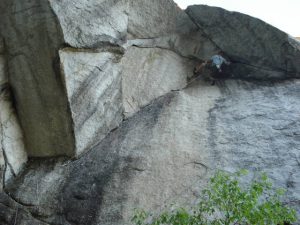 Early November, it was a little cold to go climbing in Little Cottonwood Canyon’s shady Green A Gully. Yet, with a few layers of down jackets on, the climbing was perfect. Granite can be really slippery when it’s a little too warm. On day 1, I had followed Adam’s lead to clean it again. It felt like I would need quite a few days to work the route and figure it out. The following day, Adam led the route first and I then led it clipping the preplaced gear and trying to work out the moves. I just couldn’t figure out the first move on the traverse. Maybe I was scared to “go for it” on such small gear – and the only gear above the ground. Adam was patient. Finally, I realized that if I placed my feet way higher on a far left foothold, I could use that tiny undercling that was giving me so much trouble. Next, I had to figure out the powerful layback, which had seemed so hard at first with the lack of footholds. Yet, seeing Adam climbing it, I saw that you could use the left crack for both feet and fingers. Eventually, after hanging to fiddle with with some gear, I committed to the right crack and made it up to the much welcome rest. The thin undercling holds that followed which had seemed so impossible the day before suddenly felt really solid. I stayed with it and made it to the chains. Now, I had to put all the sections together. We cleaned the route and I got right back on it. And sent on the next try. That same day! I was all the more psyched that I have only climbed a handful of times in LCC and am therefore not very familiar with this style of climbing.
The route that I thought would be my Fall project and would take me many tries came to me way quicker than I ever thought it would. I was really excited and motivated for more. Yet, winter took over the next day, leaving with me many dreams of other routes in my backyard for next year!
PS: am not the one on the pictures!!!
New Beginnings: Surfing
You see the wave swelling the distance. You turn your board to face the shore. You lay down on your board. You start paddling. You look back to make sure the wave is worth paddling for. You look back to make sure the waves isn’t going to crash on you. You feel the power of the wave lifting you. Should I stand up now? Am I too late, is it too soon? You try. You get it and you try to stand. You don’t and you sit back on the board. Either way, you look back and see the other waves forming. Now, you’re too far in to catch the coming waves and you know that they are all going to crash on you. You swim back toward them, duck diving or turtle flipping, each time, to minimize the impact. You swim again toward the next waves, and repeat the motions. Eventually, you’re back where you started. Someone asks: ” did you catch the wave?”. You sit still for a moment, catching your breath, thinking and eventually answer: “Wow, I can’t even remember now!”
Surfing is that intense, it’s that “in the moment”. There is so much to think about all that once, that for the rookie that I am, it felt completely overwhelming. Paddle, paddle, paddle, watch for people around you, put your hands flat on the board, push up, kick your feet forward, but not too far forward or the nose of your board will dip in and you’ll go flying, not too far back either or you’ll fall backwards, lower your stance, speard your arms, look in the direction of where you want to go (hmmm…. never felt like I had a choice!), never let go of your board. There is so much going on. You go from sitting calmly on your board, your legs floating in the warm Mexican water, to 100% intensity.
I met my friend Sarah in Puerto Vallarta. We had talked a month back about going somewhere together. Climbing, as always, was the first option. Yet, when she mentionned surfing, I was in. I knew nothing about it, I had never done it and I hadn’t taken a non climbing trip in as long as I can remember. After so many AMGA courses and exams back to back and guiding, I was excited to have something else to look forward to. I was also excited to postpone the start of winter and the interaction with the cold. I had always wanted to go to Mexico and it happened to be the cheapest destination. Adam was going hunting with his Dad and brother in New Hampshire. The timing couldn’t have been any better.
Sarah organized the house rental: a beautiful white Mexican house with two huge bedrooms, an open kitchen with the perfect smoothie blender, and a bean shaped swimming pool to sunbath at. We quickly settled into the following routine: an A.M. surfing session/breakfast/sunbath my the pool/ a P.M. surfing session/ Margaritas with Chips and Salsa/watching sex and the city/Mexican dinner/sleep. Repeat!
We rented board from Lily and Carlos at Pazport Surfing School (do go there if you are going to Sayulita. The best deal in town). The first day, Sarah helped me get on the board by pushing it to give me momentum. I think I was blessed with some beginner’s luck as I was able to stand up pretty much right away at the beginner waves area. But, that didn’t last long.
As soon as I headed to the regular break, reality hit hard. Without someone pushing your board, you have to paddle a lot harder and it’s really hard to find the perfect timing to get the wave right. I did get a few, but spent a whole day getting owned by the waves. I just couldn’t get it right. With my period starting simultaneously, I could have cried. How could I suck so bad? Sarah, in the meantime, was totally crushing it, standing smoothly with her bright turquoise rashguard on her beloved red board, hair in the wind…smooth sailing! That is the great thing about surfing: you can go with people of different levels and still have the time of your life because you’re both in it for yourself, yet you can still share in the experience.
Luckly for me, the next day was a full on Tropical day with gigantic waves and we opted for just watching the pros do what they do. I felt sick to my stomach at the thought of being in those waves: as the crash you can feel the power, the force they carry and getting crushed by them must be horrifying.
We woke up early the next morning to get to surf one last time. We were flying out that afternoon and had to catch the 2$ bus back to Puerto Vallarta. It was still dark out as we hiked down the stairs into the still sleepy town and onto the beach. Lily gave me a longer board – 9.6
– which made it a million times easier to catch the waves. The waves came, I paddled hard. And I got it. I got three in row. I would stand up, and wobble heavily until I would totally loose balance and fall. Yet, although I lacked any style, I felt the desire for more. I knew then that I would have to come back.
There aren’t many activities out there that force you into being fully present. Surfing is definitely one of those sports. As Sarah says, it’s not like climbing where you can try a move over and over again, lower, start again. With surfing, it’s either you catch the wave or you don’t. And you will never get to try that wave again. It’s gone, for ever. So you really need to get your act together at exactly the right time. It’s an amazing thing to be a beginner at a new sport. A new sport that you fall for that is. It felt so good to have no expectations of myself, just be there, learn, do my best and actually enjoy the process.
Now back in SLC, I can still picture the waves swelling, I want to paddle, I want to feel the waves swell below me, I want to push up and stand on the board, and obviously, from the comfort of my chair, I can see myself riding the board all the way into shore… Thank god for the power of visualization! 🙂 Instead of surfing for real now, I can surf the web in search of the next place to go and get schooled again by the waves. My dream, is to someday, surf a wave while touching the face of the wave with my hand… dreams, dreams, dreams…
New Beginnings: Surfing

You see the wave swelling the distance. You turn your board to face the shore. You lay down on your board. You start paddling. You look back to make sure the wave is worth paddling for. You look back to make sure the waves isn’t going to crash on you. You feel the power of the wave lifting you. Should I stand up now? Am I too late, is it too soon? You try. You get it and you try to stand. You don’t and you sit back on the board. Either way, you look back and see the other waves forming. Now, you’re too far in to catch the coming waves and you know that they are all going to crash on you. You swim back toward them, duck diving or turtle flipping, each time, to minimize the impact. You swim again toward the next waves, and repeat the motions. Eventually, you’re back where you started. Someone asks: ” did you catch the wave?”. You sit still for a moment, catching your breath, thinking and eventually answer: “Wow, I can’t even remember now!”
Surfing is that intense, it’s that “in the moment”. There is so much to think about all that once, that for the rookie that I am, it felt completely overwhelming. Paddle, paddle, paddle, watch for people around you, put your hands flat on the board, push up, kick your feet forward, but not too far forward or the nose of your board will dip in and you’ll go flying, not too far back either or you’ll fall backwards, lower your stance, speard your arms, look in the direction of where you want to go (hmmm…. never felt like I had a choice!), never let go of your board. There is so much going on. You go from sitting calmly on your board, your legs floating in the warm Mexican water, to 100% intensity.
I met my friend Sarah in Puerto Vallarta.  We had talked a month back about going somewhere together. Climbing, as always, was the first option. Yet, when she mentionned surfing, I was in. I knew nothing about it, I had never done it and I hadn’t taken a non climbing trip in as long as I can remember. After so many AMGA courses and exams back to back and guiding, I was excited to have something else to look forward to. I was also excited to postpone the start of winter and the interaction with the cold. I had always wanted to go to Mexico and it happened to be the cheapest destination. Adam was going hunting with his Dad and brother in New Hampshire. The timing couldn’t have been any better.
Sarah organized the house rental: a beautiful white Mexican house with two huge bedrooms, an open kitchen with the perfect smoothie blende r, and a bean shaped swimming pool
to sunbath at. We quickly settled into the following routine: an A.M. surfing session/breakfast/sunbath my the pool/ a P.M. surfing session/ Margaritas with Chips and Salsa/watching sex and the city/Mexican dinner/sleep. Repeat!
We rented board from Lily and Carlos at Pazport Surfing School (do go there if you are going to Sayulita. The best deal in town). The first day, Sarah helped me get on the board by pushing it to give me momentum. I think I was blessed with some beginner’s luck as I was able to stand up pretty much right away at the beginner waves area. But, that didn’t last long.
As soon as I headed to the regular break, reality hit hard. Without someone pushing your board, you have to paddle a lot harder and it’s really hard to find the perfect timing to get the wave right. I did get a few, but spent a whole day getting owned by the waves. I just couldn’t get it right. With my period starting simultaneously, I could have cried. How could I suck so bad? Sarah, in the meantime, was totally crushing it, standing smoothly with her bright turquoise rashguard on her beloved red board, hair in the wind…smooth sailing! That is the great thing about surfing: you can go with people of different levels and still have the time of your life because you’re both in it for yourself, yet you can still share in the experience.
Luckly for me, the next day was a full on Tropical day with gigantic waves and we opted for just watching the pros do what they do. I felt sick to my stomach at the thought of being in those waves: as the crash you can feel the power, the force they carry and getting crushed by them must be horrifying.
We woke up early the next morning to get to surf one last time. We were flying out that afternoon and had to catch the 2$ bus back to Puerto Vallarta. It was still dark out as we hiked down the stairs into the still sleepy town and onto the beach. Lily gave me a longer board – 9.6 – which made it a million times easier to catch the waves. The waves came, I paddled hard. And I got it. I got three in row. I would stand up, and wobble heavily until I would totally loose balance and fall. Yet, although I lacked any style, I felt the desire for more. I knew then that I would have to come back.
There aren’t many activities out there that force you into being fully present. Surfing is definitely one of those sports. As Sarah says, it’s not like climbing where you can try a move over and over again, lower, start again. With surfing, it’s either you catch the wave or you don’t. And you will never get to try that wave again. It’s gone, for ever. So you really need to get your act together at exactly the right time. It’s an amazing thing to be a beginner at a new sport. A new sport that you fall for that is. It felt so good to have no expectations of myself, just be there, learn, do my best and actually enjoy the process.
Now back in SLC, I can still picture the waves swelling, I want to paddle, I want to feel the waves swell below me, I want to push up and stand on the board, and obviously, from the comfort of my chair, I can see myself riding the board all the way into shore… Thank god for the power of visualization! 🙂 Instead of surfing for real now, I can surf the web in search of the next place to go and get schooled again by the waves. My dream, is to someday, surf a wave while touching the face of the wave with my hand… dreams, dreams, dreams…
Part II: Rock Exam


Part II: Rock Exam in Red Rocks, Nevada
Transitioning from an Alpine Exam to a Rock Exam isn’t so hard. No more snow, no more ice, which means no more snow/ice gear to carry around, no more alpine hazards (crevasses, seracs, white out navigation, etc.), no more camping on snow, no more multiple hour long approaches, no more carrying your living quarters and several days worth of food on your back like a turtle. Of course, you’re totally out of climbing shape, with big legs and small arms (hmmm, that actually is never my case). But a month between exams felt just like the right amount of time to rest up, remotivate, and train enough to be at or above the minimum standard: 5.10c trad.
The date was set for my friend Jonathon Spitzer and I to leave our respective homes in Salt Lake City and head south on Sept 8th to start our training. The exam was due to start on October 1st and with 22 days at hand, we headed down to Vegas to start the process. One route in 100F shade instantly made us get back in the car and drive on to the coolness of one of California’s very hidden treasures: The Needles.
The Needles is a little paradise of splitter, flashy, yellow lichen-covered granite cracks lost in the heart and shade of giant Sequoia trees, miles and miles away from anything. It’s an enchanted kingdom given away by the names of the Needles: The Sorcerer, the Witch, the Charlatan, etc. and the routes: Spellbook, Spooky, Spooked Book, to name a few. We spent three days hiking 3 miles in and 3 miles out from the free campground at the trailhead to the base of the climbs, climbing our hearts out. This was the perfect place to get back into rock climbing: all the cracks protect well, the climbing is amazing and we were both motivated to get as much mileage as possible. We totaled 22 pitches in 3 days of climbing.
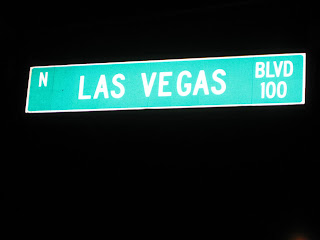
We used our rest day to drive back to Vegas and get there early enough to get the best spots in the house the 12 exam candidates had rented. Pulling into the driveway reminded me of Wisteria Lane or worse, the Truman Show. I wondered if people really lived in these cookie cutter off-white houses or, like everything else in Vegas, was it all for show? Yet, that’s what I love about Vegas the most: the extreme contrast between the fake and flashy, and that intense wilderness found within Red Rocks Canyon, just a few miles to the north of Vegas. After days spent bushwhacking in the scrub oaks, boulder hopping in the washes, running down vast multicolored slab systems, climbing on multipitch red, white or varnished sandstone routes while enduring the blazing sun and the relentless heat – even in the shade, it felt soothing to go back to the bright lights, the tamed cleanliness of our neighboorhood, give into the drastic cold of the A/C and wash off the sweat, the stinging leaves and the invading sand off our bodies, share the days adventure with the other housemates and later rest our heads on a clean pillow all while surfing the web and watching Grey’s Anatomy. OK, I may sound spoiled.

Yet, if you’ve ever spent weeks at a time in Afghanistan – aka, the campground outside Red Rocks – you’ll appreciate all the more what I am talking about.


Living with 12 people training for an exam can be overwhelming – beta overload, nonstop talk of climbing – but as well, very stimulating.
For someone like me who suffers from acute case of FOMO – Fear Of Missing Out – it can be a little hard to manage. So, out of 18 days of training, I only took two days off. When I started crying at the sight of gear, and had to hold on to the railing to walk down the stairs because every bone in my body was screaming out for me to take it easy, I decided to head out to Lake Mead to soak in the water. In past years, it was easy to train. The same routes were used over and over again: Community Pillar, Epinephrine, Triassic Sands, Dark Shadows to the top, Black Orpheus, Solar Slabs, Frigid Air Buttress, Ginger Cracks, etc. Obviously, all candidates would go out and do these routes ahead of time, figuring out how to break down the route down – the goal being that you always try to see your client and the guidebook’s recommended belay stances don’t always fit that goal – , where to extend anchors, when to transition from one rope to two ropes (with two clients), whether to lower clients or do a prerigged rappel, where to short rope, etc. Having these sections dialed alleviates a lot of the stress on an exam. Yet, it takes away from the examiner’s ability to test your onsight skills. So, with word on the street that only “new” routes would be used, we ransacked the place climbing just about every other possible option of routes in the 5.8 to 5.10c range.
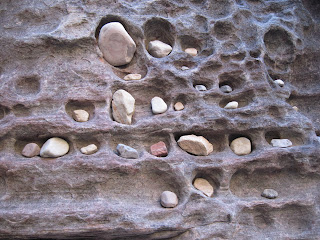
With 100+F temperatures, it was only possible to climb routes in the shade. Joe Stock, Jonathon Spitzer – for both of whom this was the last exam to get the IFMGA certification, aka, The Pin – and I regrettably ventured one day on a sunny varnished climb. At the end of the day, Joe was showing blisters on all his finger tips from the sizzling black rock. , Not having been able to preview sunny routes, we all started praying that the temperatures would remain high so that we would only climb the shaded route we had previously sussed out during the exam.
Yet, Murphy’s law ruled again: as we neared the exam, temperatures dropped from 105F to 75F in a day! Now, we were all granted to do routes in the sun, routes we had not done before: there was no way around onsighting. And indeed, out of 6 days of exam, I only got to do one route I had done before: Epinephrine, a 2000ft long sustained 5.9 route in Black Velvet Canyon, which is renown for what the European that I partially am doesn’t do: blank varnished chimneys, well…chimneys alltogether. Ok, they are protectable and thankfully, Jonathon and I had stopped to do this route on our way to the Needles. So I was somewhat ready for them. The crux on these exams is that you climb with two single rated ropes in tow and that adds to the weight and to the rope drag. That, plus managing your back pack that is dangling between your legs and leading runout (I didn’t bring enough gear) sections on what might as well be 12a in my book, and still pretend that my examiner and the other candidate are my clients and should be treated as such (haul their packs!) was the crux of my exam. A good crux though, one that makes me want to get better at wider climbing.

Day one of the exam, all the candidates went sport climbing to get tested on our climbing abilities. My group of four – Josh Beckner, Mark Smiley, Chris Werner and myself – headed out with our examiners – Marc Chauvin and Dale Remsberg (the same examiners I had on my alpine exam) to The Gallery at the Second Pullout off the Loop road. The goal was to climb 7 pitches with at least one route at the standard. If we could onsight the classic slightly overrated 5.11d Yaak Crack, we would only have to climb 5 routes. Since we all onsighted the route, our day ended early enough for us to get ready for the following four days. The third day was cancelled due to a huge wind storm that ripped through Vegas with 77mph winds. In exchange for our rest day, we were assigned a bigger day the following day. Mark Chauvin assigned Mark Smiley and Myster Z to Nightcrawler to the Hourglass Diversion, down the Gunsight notch, which awarded us with 13 pitches of climbing, some bushwhacking, lots of walking, some interesting claustrophobic tunnelling and a hike out with my Petzl e+LITE headlamp showing the way. The last day, Mark and I were assigned Cat in the Hat with Dale. Dale is a 5.12/13 climber, who, on that day, was playing the role of a 5.5 climber getting on his first ever multipitch. Upon reaching the base of this very popular climb, we heard voices of several teams gearing up to get on the climb. What to do? We didn’t have the whole guidebook with us, we had a “weak” client along, options were really limited. I pulled the “it’s our last day on our rock exam, we are all guides” card and thankfully, it worked. Did I mention how grateful we were to these two parties for letting us pass? The alternative would have been a really bad/stressful way to end the last day on this rock exam.

After a quick debrief back at the campground with our examiners, we all got ready to do what Vegas is really known for: partying into the wee hours of the morning. Adam – my husband and I – had rented a cheap – 19$ room right on Fremont – aka Freakmont – street to make sure we could indulge guiltlessly in the Vegas experience. We celebrated the end of our exam, which meant for Joe Stock and Jonathon Spitzer getting their IFMGA certification. But we also celebrated Adam’s Pin, which he had just received two weeks earlier after completing his alpine exam in the Cascades.


We drove back to snow in Salt Lake City. Winter is now right around the corner. And it’ll soon be time for me to start focusing on my last exam: the ski. With two exams down in a little over a month, I am now secretly hoping that maybe, sometime sooner than later, will come the time for me to celebrate my own IFMGA pin. Sweet dreams are made of these…
Thanks to Joe Stock and Christopher Wright for some of the pictures…
Check out Joe’s website for more pictures of the exam and Christopher Wright’s blog for a full story of Adventure Punks
Part II: Rock Exam
Transitioning from an Alpine Exam to a Rock Exam isn’t so hard. No more snow, no more ice, which means no more snow/ice gear to carry around, no more alpine hazards (crevasses, seracs, white out navigation, etc.), no more camping on snow, no more multiple hour long approaches, no more carrying your living quarters and several days worth of food on your back like a turtle. Of course, you’re totally out of climbing shape, with big legs and small arms (hmmm, that actually is never my case). But a month between exams felt just like the right amount of time to rest up, remotivate, and train enough to be at or above the minimum standard: 5.10c trad.
The date was set for my friend Jonathon Spitzer and I to leave our respective homes in Salt Lake City and head south on Sept 8th to start our training. The exam was due to start on October 1st and with 22 days at hand, we headed down to Vegas to start the process. One route in 100F shade instantly made us get back in the car and drive on to the coolness of one of California’s very hidden treasures: The Needles.
The Needles is a little paradise of splitter, flashy, yellow lichen-covered granite cracks lost in the heart and shade of giant Sequoia trees, miles and miles away from anything. It’s an enchanted kingdom given away by the names of the Needles: The Sorcerer, the Witch, the Charlatan, etc. and the routes: Spellbook, Spooky, Spooked Book, to name a few. We spent three days hiking 3 miles in and 3 miles out from the free campground at the trailhead to the base of the climbs, climbing our hearts out. This was the perfect place to get back into rock climbing: all the cracks protect well, the climbing is amazing and we were both motivated to get as much mileage as possible. We totaled 22 pitches in 3 days of climbing.
We used our rest day to drive back to Vegas and get there early enough to get the best spots in the house the 12 exam candidates had rented. Pulling into the driveway reminded me of Wisteria Lane or worse, the Truman Show. I wondered if people really lived in these cookie cutter off-white houses or, like everything else in Vegas, was it all for show? Yet, that’s what I love about Vegas the most: the extreme contrast between the fake and flashy, and that intense wilderness found within Red Rocks Canyon, just a few miles to the north of Vegas. After days spent bushwhacking in the scrub oaks, boulder hopping in the washes, running down vast multicolored slab systems, climbing on multipitch red, white or varnished sandstone routes while enduring the blazing sun and the relentless heat – even in the shade, it felt soothing to go back to the bright lights, the tamed cleanliness of our neighboorhood, give into the drastic cold of the A/C and wash off the sweat, the stinging leaves and the invading sand off our bodies, share the days adventure with the other housemates and later rest our heads on a clean pillow all while surfing the web and watching Grey’s Anatomy. OK, I may sound spoiled.
Yet, if you’ve ever spent weeks at a time in Afghanistan – aka, the campground outside Red Rocks – you’ll appreciate all the more what I am talking about.
Living with 12 people training for an exam can be overwhelming – beta overload, nonstop talk of climbing – but as well, very stimulating. For someone like me who suffers from acute case of FOMO – Fear Of Missing Out – it can be a little hard to manage. So, out of 18 days of training, I only took two days off. When I started crying at the sight of gear, and had to hold on to the railing to walk down the stairs because every bone in my body was screaming out for me to take it easy, I decided to head out to Lake Mead to soak in the water. In past years, it was easy to train. The same routes were used over and over again: Community Pillar, Epinephrine, Triassic Sands, Dark Shadows to the top, Black Orpheus, Solar Slabs, Frigid Air Buttress, Ginger Cracks, etc. Obviously, all candidates would go out and do these routes ahead of time, figuring out how to break down the route down – the goal being that you always try to see your client and the guidebook’s recommended belay stances don’t always fit that goal – , where to extend anchors, when to transition from one rope to two ropes (with two clients), whether to lower clients or do a prerigged rappel, where to short rope, etc. Having these sections dialed alleviates a lot of the stress on an exam. Yet, it takes away from the examiner’s ability to test your onsight skills. So, with word on the street that only “new” routes would be used, we ransacked the place climbing just about every other possible option of routes in the 5.8 to 5.10c range.
With 100+F temperatures, it was only possible to climb routes in the shade. Joe Stock, Jonathon Spitzer – for both of whom this was the last exam to get the IFMGA certification, aka, The Pin – and I regrettably ventured one day on a sunny varnished climb. At the end of the day, Joe was showing blisters on all his finger tips from the sizzling black rock. , Not having been able to preview sunny routes, we all started praying that the temperatures would remain high so that we would only climb the shaded route we had previously sussed out during the exam.
Yet, Murphy’s law ruled again: as we neared the exam, temperatures dropped from 105F to 75F in a day! Now, we were all granted to do routes in the sun, routes we had not done before: there was no way around onsighting. And indeed, out of 6 days of exam, I only got to do one route I had done before: Epinephrine, a 2000ft long sustained 5.9 route in Black Velvet Canyon, which is renown for what the European that I partially am doesn’t do: blank varnished chimneys, well…chimneys alltogether. Ok, they are protectable and thankfully, Jonathon and I had stopped to do this route on our way to the Needles. So I was somewhat ready for them. The crux on these exams is that you climb with two single rated ropes in tow and that adds to the weight and to the rope drag. That, plus managing your back pack that is dangling between your legs and leading runout (I didn’t bring enough gear) sections on what might as well be 12a in my book, and still pretend that my examiner and the other candidate are my clients and should be treated as such (haul their packs!) was the crux of my exam. A good crux though, one that makes me want to get better at wider climbing.
Day one of the exam, all the candidates went sport climbing to get tested on our climbing abilities. My group of four – Josh Beckner, Mark Smiley, Chris Werner and myself – headed out with our examiners – Marc Chauvin and Dale Remsberg (the same examiners I had on my alpine exam) to The Gallery at the Second Pullout off the Loop road. The goal was to climb 7 pitches with at least one route at the standard. If we could onsight the classic slightly overrated 5.11d Yaak Crack, we would only have to climb 5 routes. Since we all onsighted the route, our day ended early enough for us to get ready for the following four days. The third day was cancelled due to a huge wind storm that ripped through Vegas with 77mph winds. In exchange for our rest day, we were assigned a bigger day the following day. Mark Chauvin assigned Mark Smiley and Myster Z to Nightcrawler to the Hourglass Diversion, down the Gunsight notch, which awarded us with 13 pitches of climbing, some bushwhacking, lots of walking, some interesting claustrophobic tunnelling and a hike out with my Petzl e+LITE headlamp showing the way. The last day, Mark and I were assigned Cat in the Hat with Dale. Dale is a 5.12/13 climber, who, on that day, was playing the role of a 5.5 climber getting on his first ever multipitch. Upon reaching the base of this very popular climb, we heard voices of several teams gearing up to get on the climb. What to do? We didn’t have the whole guidebook with us, we had a “weak” client along, options were really limited. I pulled the “it’s our last day on our rock exam, we are all guides” card and thankfully, it worked. Did I mention how grateful we were to these two parties for letting us pass? The alternative would have been a really bad/stressful way to end the last day on this rock exam.
After a quick debrief back at the campground with our examiners, we all got ready to do what Vegas is really known for: partying into the wee hours of the morning. Adam – my husband and I – had rented a cheap – 19$ room right on Fremont – aka Freakmont – street to make sure we could indulge guiltlessly in the Vegas experience. We celebrated the end of our exam, which meant for Joe Stock and Jonathon Spitzer getting their IFMGA certification. But we also celebrated Adam’s Pin, which he had just received two weeks earlier after completing his alpine exam in the Cascades.
We drove back to snow in Salt Lake City. Winter is now right around the corner. And it’ll soon be time for me to start focusing on my last exam: the ski. With two exams down in a little over a month, I am now secretly hoping that maybe, sometime sooner than later, will come the time for me to celebrate my own IFMGA pin. Sweet dreams are made of these…
Thanks to Joe Stock and Christopher Wright for some of the pictures…
Check out Joe’s website for more pictures of the exam and Christopher Wright’s blog for a full story of Adventure Punks